Looking for something specific? Browse all of our articles by topic in the Rocky Point Real Estate Guide — your complete resource for buying, selling, and living in Puerto Peñasco.

Rocky Point Real Estate News

My name is Joseph Sanchez and for over ten years I have helped foreigners design and build custom homes while closing real estate transactions that achieve dreams. I write articles that share my real estate experience in Mexico and discuss topics important to you such as investment opportunities, market trends, the economy, home building and the process of owning real estate in Puerto Peñasco, Mexico. During those years, I have evolved into a developer focused on building and selling new homes that are currently available for sale.  I share my expertise with you here so that you can make an informed decision to achieve YOUR Mexican Dream. I am married for over 20 years and blessed with three beautiful children who I raise here with my wife Myrna who was born and raised in Puerto Peñasco. I have a B.A. in Speech Communication with a specialization in Public Relations from Southern Illinois University at Carbondale, an Iraq War veteran and I am originally from Chicago. To learn more about purchasing property in Puerto Peñasco please schedule your personal Mexican Real Estate Consultation , a one-on-one zoom meeting designed to educate and answer all your questions. 

Aug. 17, 2026

Vista Del Mar: Ocean-View Homes in Playa Encanto, Built Smarter

By Joseph Sanchez, Team Sanchez · RE/MAX Legacy

Last updated: August 2026

House #1 at twilight, Vista Del Mar, Playa Encanto

House #1 at twilight — Vista Del Mar, Playa Encanto.

Some homes have an ocean view. These were designed around it. At Vista Del Mar in Playa Encanto, the homes face south toward the Sea of Cortez, so the same wall of glass gives you the sunrise and the sunset — and an ocean-facing wall of 8-foot glass doors and windows pulls the whole horizon inside. It sits on one of the best-positioned stretches of Playa Encanto, the longest and quietest run of sand in Rocky Point. But the reason these homes stand apart isn’t just the view — it’s how they’re built.

The Homes

Two contemporary models, one- and two-story, each with 4 bedrooms and 3 full baths, an oversized 2-to-3-car garage, and a great room that runs kitchen, dining, and living together and opens to the sea. The two-story adds a family room with a wet bar and a pair of private European-style balconies. Both come fully equipped — refrigerator, cooktop and oven, dishwasher, microwave, wine-and-beverage cooler, even a mini-fridge at the wet bar — with solid-wood interior doors and low-maintenance fiberglass exterior doors throughout.

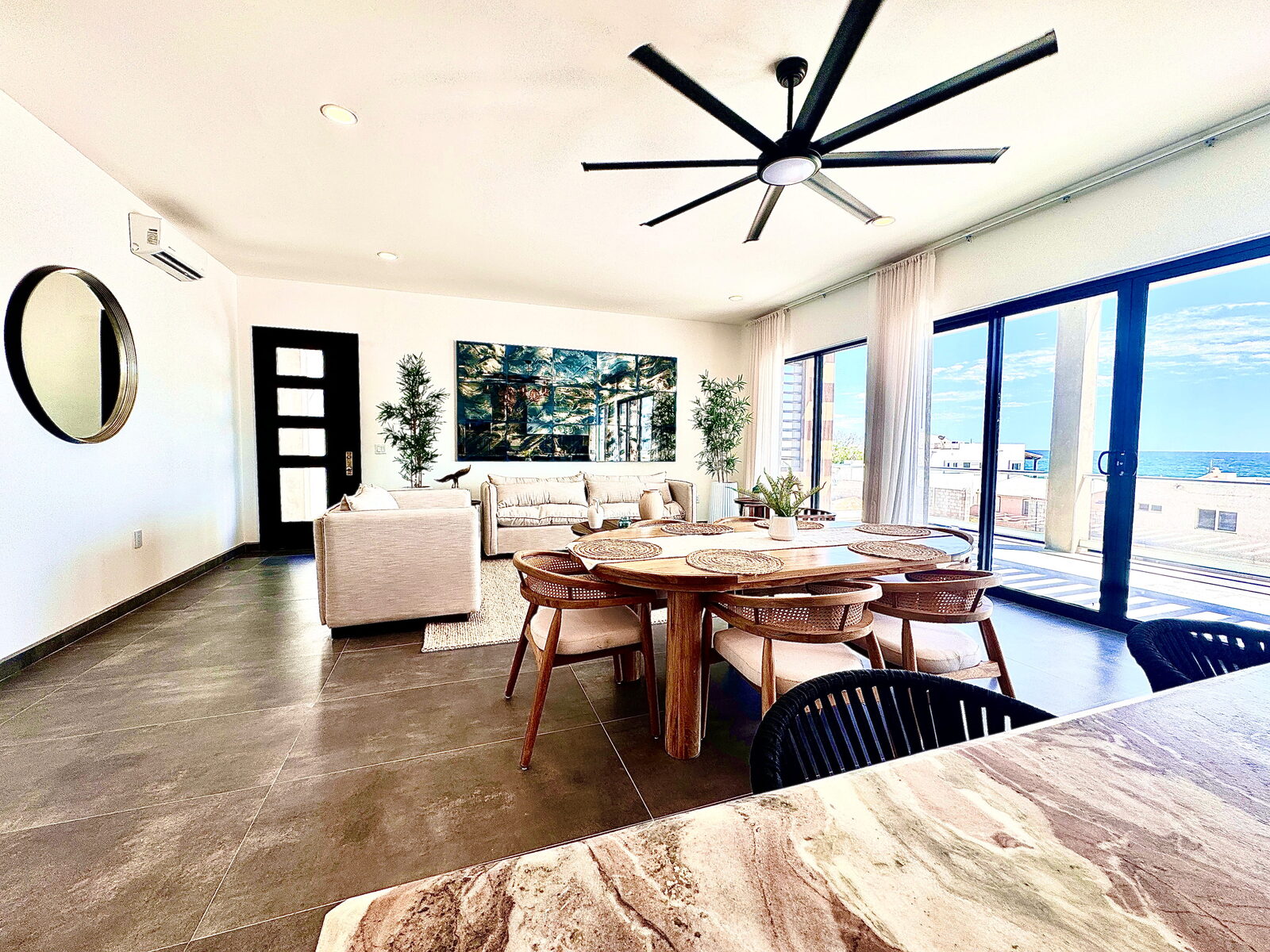
Great room open to the ocean at Vista Del Mar

The great room opens to the sea through a wall of 8-ft glass.

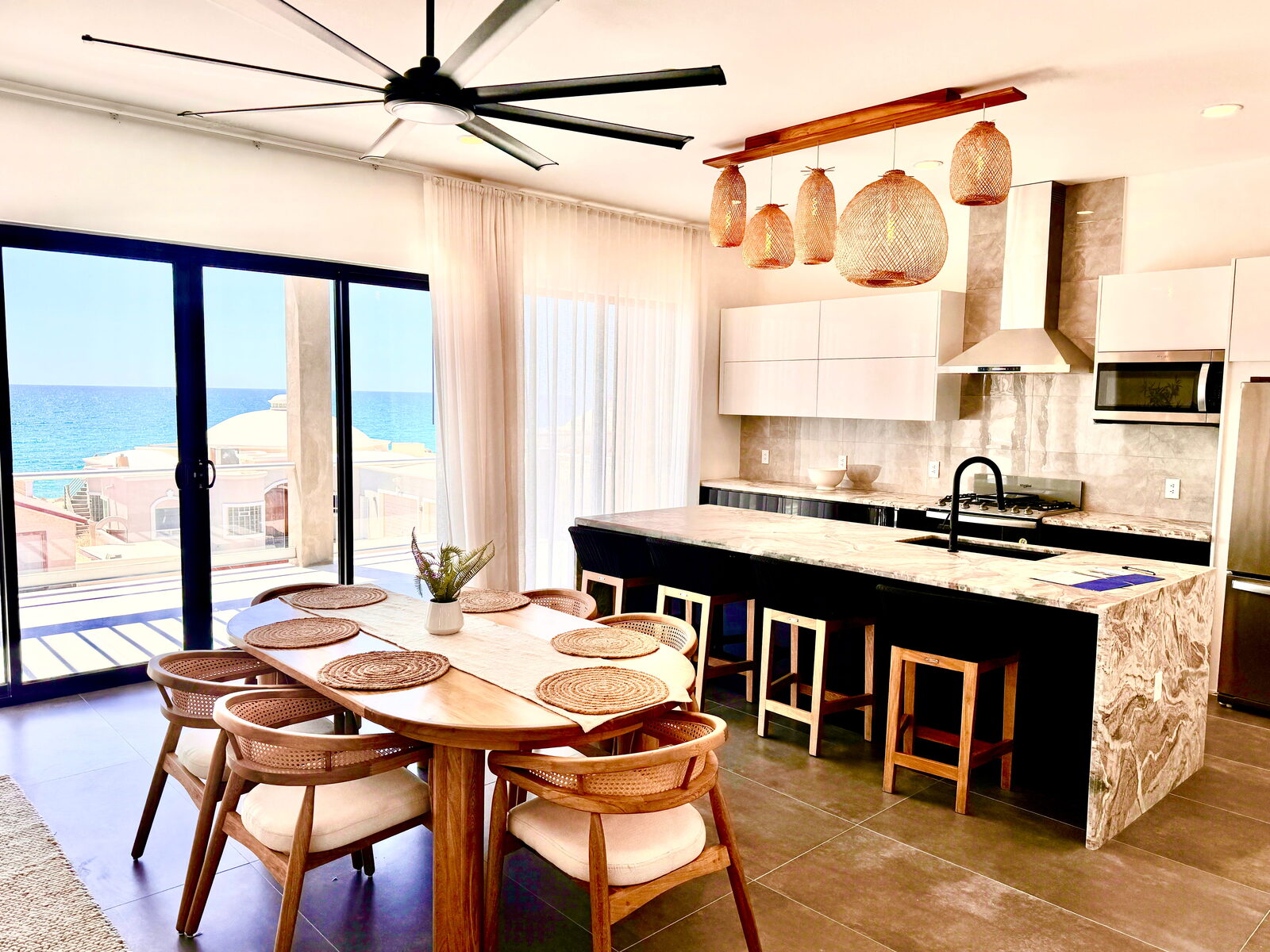
Kitchen with marble waterfall island and ocean view at Vista Del Mar

A chef’s kitchen with a marble waterfall island — and an ocean view.

  1-Story 2-Story
Livable space 2,030 sq ft 2,241 sq ft
Bed / bath 4 bed · 3 bath 4 bed · 3 bath
Garage 704 sq ft (2–3 car) 650 sq ft (2–3 car)
Total under roof 3,312 sq ft 3,755 sq ft

Built to Last — and to Save

This is where Vista Del Mar separates from the pack. The homes are built with Fastblocs insulated concrete form construction — a solid, storm- and heat-resistant building envelope shown to cut energy use by 50–60%. In a climate where cooling is the biggest line on a utility bill, that difference compounds year after year.

  • Dual-pane windows with solar film that block 90%+ of harmful UV and reject 60–70% of the sun’s heat.
  • Zoned mini-split climate control — a unit in every bedroom plus two in the great rooms, so you condition only the space you’re using.
  • Energy Star appliances throughout.
  • 10-foot ceilings and skylights that flood the interior with natural light while the envelope keeps the heat out.

Behind it all is a builder with a real track record: Victor & Sergio Elenes of Beraca Custom Homes, with more than 30 years and hundreds of homes built across Sonora, a team of three civil engineers and an architect, and a 5-year warranty on structural work. You can read the full construction story on the Vista Del Mar site.

The Setting

Playa Encanto is Rocky Point’s long game: 8-plus miles of low-density, smooth-sand, family-friendly beach with no rocks — the kind of shoreline you walk for an hour without crossing a crowd. Vista Del Mar sits adjacent to the community’s guard gate, with 24/7 security patrol, and Starbucks, El Coyote Restaurant, and the Blue Harbor store are less than a mile away — or a 15-minute walk up the beach. HOA dues are a modest $100 a month (PENCA), covering the guard gate, security, road maintenance, and trash.

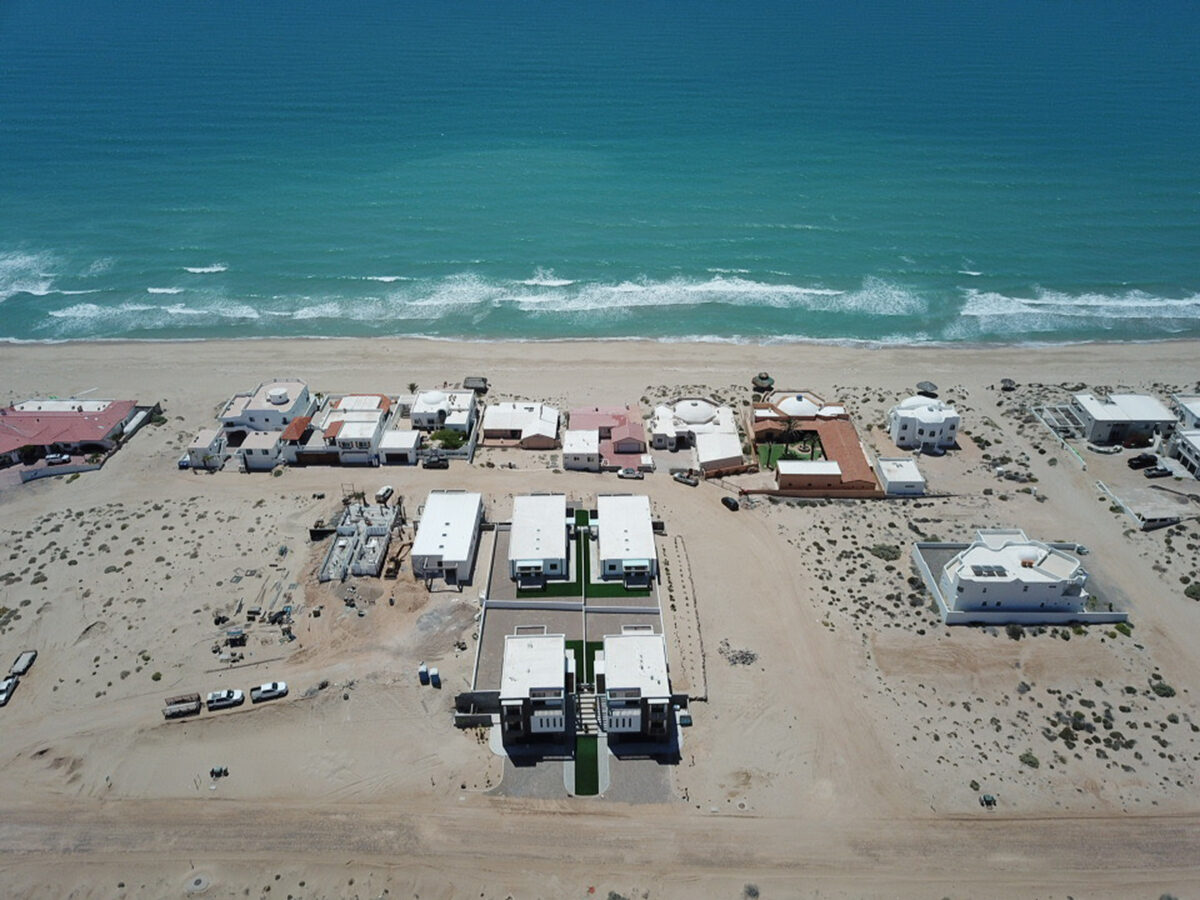
Vista Del Mar on the Sea of Cortez, Playa Encanto

Vista Del Mar on the Sea of Cortez, Playa Encanto.

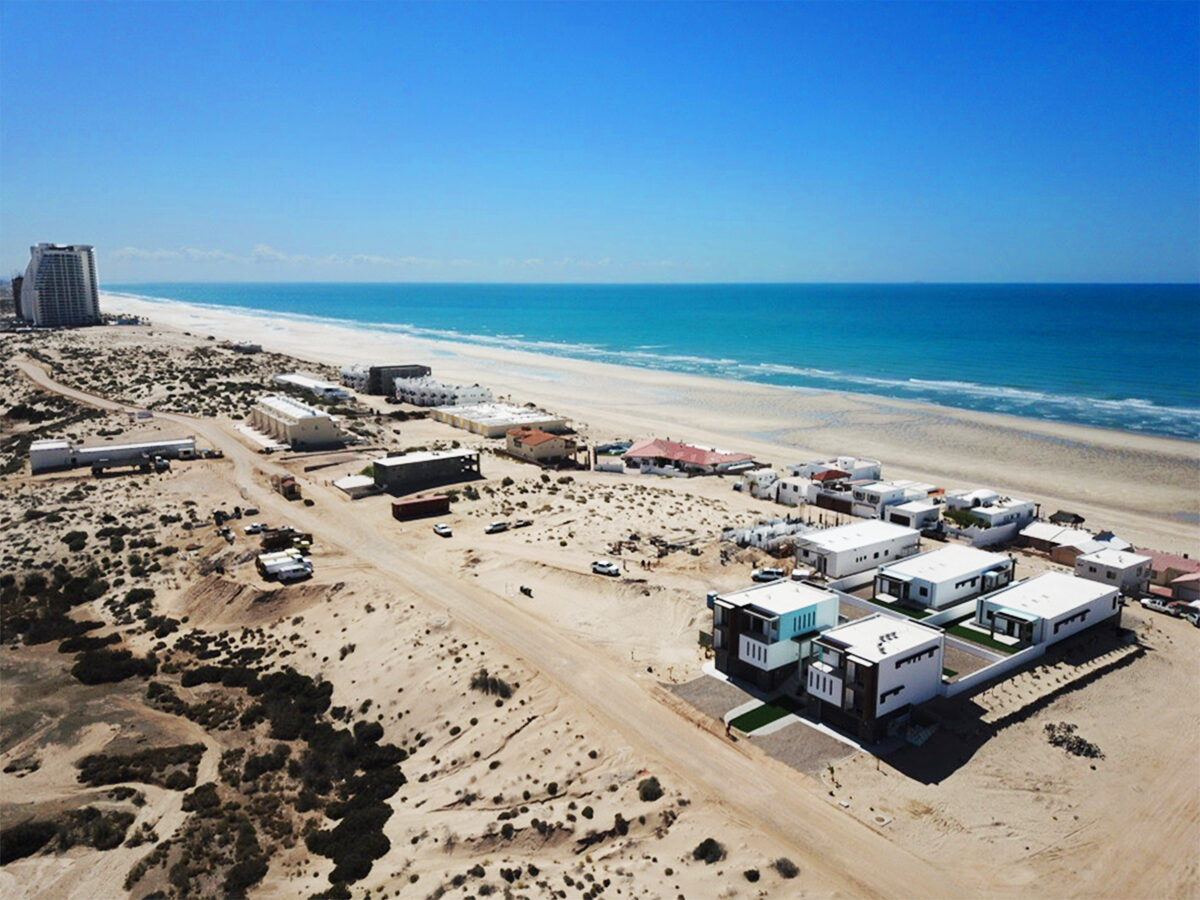
Eight-plus miles of Playa Encanto beach

Eight-plus miles of low-density Playa Encanto beach.

The Numbers

Both models are priced the same, with a cash price and a financed price — and the seller is offering direct financing, so there’s no foreign-bank hurdle to clear.

$649,000 financed  ·  $599,000 cash
Both models · 4 bed / 3 bath · all appliances included
Financing option A: 50% down · 6.9% · 10-year amortization with a 5-year balloon → ≈ $3,751/mo
Financing option B: 40% down · 7.9% · 10-year amortization with a 5-year balloon → ≈ $4,704/mo

Both financing paths keep payments manageable now and leave a balance due at year five — most owners refinance, sell, or pay it off from a strong equity position by then. When you reach out, I’ll run the exact numbers, including your down payment and closing costs, for your situation.

How It’s Held

The Vista Del Mar homes and lots are held in a U.S. LLC, which can make for a cleaner acquisition and some real ownership advantages on the tax and estate-planning side. That’s a conversation worth having with the right professionals before you buy — I work with a cross-border tax accountant and a notario and can get you on a call with them so it’s structured correctly for you.

The Bottom Line

Ocean-facing, energy-smart, move-in ready, backed by a serious builder and a 5-year structural warranty, in the quietest stretch of Playa Encanto — with seller financing on the table. Homes that check this many boxes don’t come along often. If you’d like to see one in person, I can arrange a private showing with a little notice.

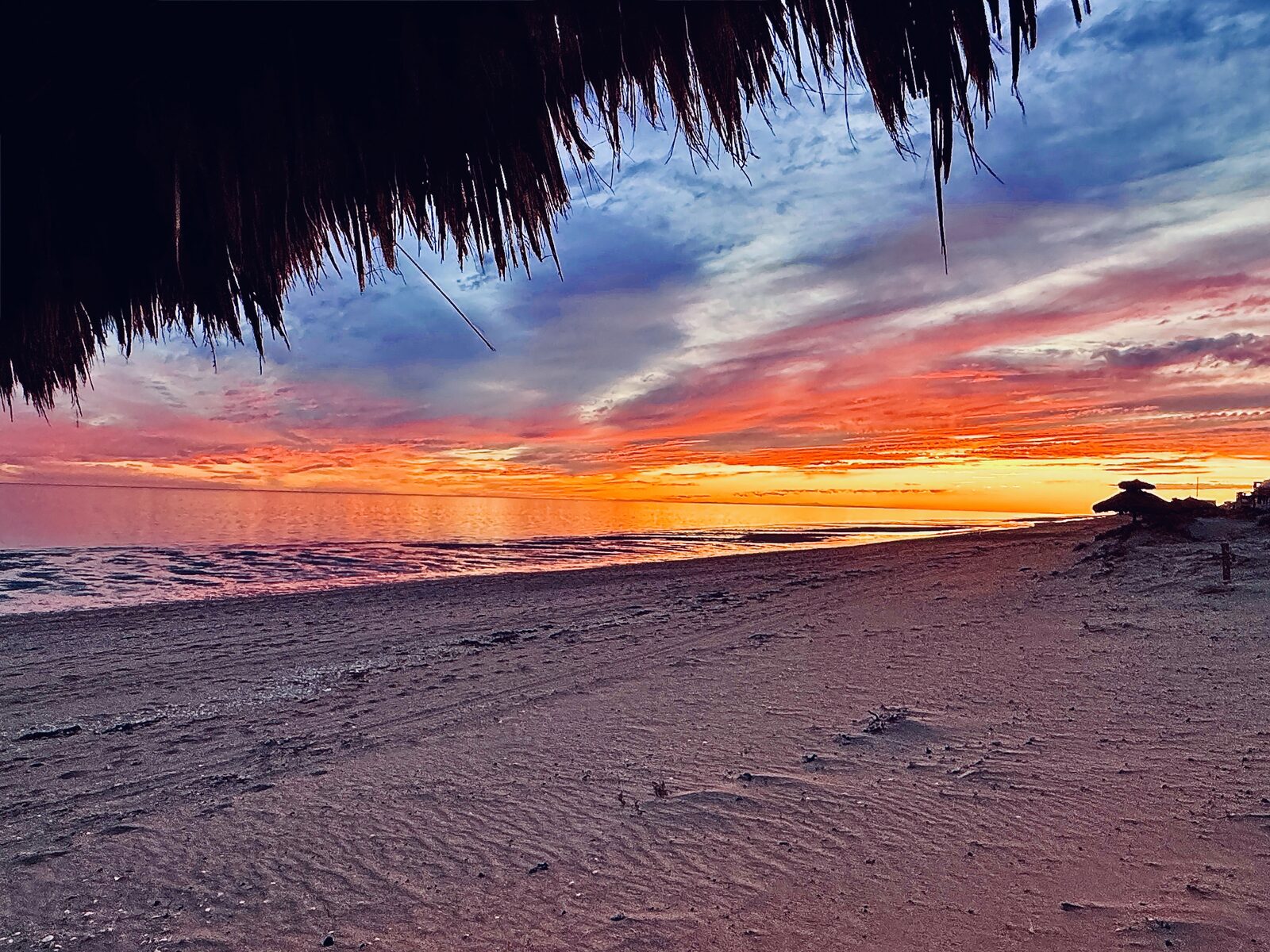
Sunset over Playa Encanto

Sunset over Playa Encanto — the everyday view from Vista Del Mar.

See more photos and floor plans at vistadelmarhomes.com.

Want a private walk-through, or to pencil out the financing for your situation? Book a meeting with me and we’ll take it from there. No pressure, no obligation.

I’m a real estate broker, not an attorney or accountant. Seller financing, U.S. LLC ownership, and any cross-border (U.S./Mexico) purchase carry legal and tax details that should be reviewed with a Mexican tax accountant (contador) and a licensed notario público, and all pricing and terms should be confirmed in writing. Payment figures are illustrative estimates; specifications and pricing are provided by the developer and subject to change.

Joseph Sanchez is an AMPI-certified real estate agent with RE/MAX Legacy and the developer of Viviente at Sandy Beach. He serves as president of Rocky Point Home Builders and is a proud U.S. Veteran. Originally from Chicago and a Southern Illinois University at Carbondale alumnus, Joseph now resides full-time in Puerto Peñasco with his wife and three children for over 15 years. For more information email rockypointrealestate911@gmail.com.

Aug. 10, 2026

The Sandy Beach Condo That Helps Pay for Itself: Seller Financing at 502 West, Sonoran Sea

By Joseph Sanchez, Team Sanchez · RE/MAX Legacy

Last updated: August 2026

Ocean-view balcony at 502 West, Sonoran Sea Resort, Sandy Beach, Puerto Penasco

Slide open the balcony door and the Sea of Cortez is right there, rolling onto Sandy Beach. It is an easy condo to fall for. But the reason to call me about this one isn’t the view — it’s the numbers, and how they line up. This unit brings together three things you rarely see on one beachfront condo: seller financing, rental income that covers the payment, and a rare chance to hold title in a way that can legally eliminate your taxes. Let’s walk through all three.

The rare part: the seller will finance you

No foreign bank, no cross-border mortgage maze. The owner will carry the note directly, so you can own a beachfront condo in Rocky Point without a U.S. or Mexican bank in the middle. Here is the structure on the table:

Price: $345,000  ·  Down (50%): $172,500  ·  Financed: $172,500
Rate: 7%  ·  Term: 5 years  ·  Payment: about $1,550/month

To keep that monthly payment low, the payments are calculated on a longer schedule, with the remaining balance due at the end of year five (more on that below — it’s a strength here, not a catch).

The part investors like: your renters help pay it down

Sandy Beach is one of the most rental-friendly stretches of coastline in Puerto Peñasco, and a turnkey condo in the sought-after West building rents well. At around $350 a night and a realistic 6 to 10 booked nights a month, here is how the monthly rental income stacks up against that ~$1,550 payment:

Booked nights / month Rental income / month After the ~$1,550 payment
6 nights $2,100 +$550
8 nights $2,800 +$1,250
10 nights $3,500 +$1,950

Every row is positive. Even at the conservative six-night floor, the rental income covers the loan payment with room to spare. Over the full five years, guests contribute somewhere in the range of $126,000 to $210,000 toward a property you financed for $172,500.

A straight-shooter’s note: those are gross rental figures. Real-world costs — property management, HOA dues, utilities, cleaning, and predial (property tax) — come out of them. The point isn’t that it’s free; it’s that the income does the heavy lifting on your payment instead of coming out of your pocket. When you call, we’ll run your actual net together.

How you hold title — the piece most agents skip

Here’s an advantage that never shows up in listing photos, and most agents never raise it. The current owner is a Mexican national holding clean, direct title — which makes this sale a blank slate. Instead of putting a bank trust (fideicomiso) in your own name, you have the opportunity to take title into a U.S. LLC and set the structure up right from day one. How you hold title to the property changes your economics in three real ways:

  • At closing — legally eliminate the ~3% transfer tax. Taking title through a U.S. LLC, rather than a fideicomiso in your own name, can be structured to legally eliminate the roughly 3% city transfer/acquisition tax — trimming your total closing costs by about 4%.
  • At sale — legally minimize or eliminate capital gains. When you’re ready to exit, you sell the company that owns the unit instead of the property itself. Structured properly, this can legally minimize — or eliminate entirely — the capital-gains tax on your sale, in a market where the gain-based rate can run 35% or more. It also makes you an easier sell, because your buyer legally eliminates that ~3% transfer tax too. That’s a listing advantage most sellers can’t offer.
  • For your family — clean succession and asset protection. Held in a U.S. LLC or a family trust, the property can pass to your heirs and be held for asset protection — keeping it out of Mexican probate and making cross-border succession simple.

One honest note so you have the whole picture: a U.S. LLC carries modest ongoing accounting and filing obligations — a local accountant handles it for a small annual cost, and your rental income is reported through the company. It doesn’t change the core advantage; it just comes with the territory.

These are exactly the details to pressure-test before you commit, and I’m a broker — not your tax or legal advisor. I work with a Mexican tax accountant and a notario who structure these every day, and I’ll get you on a call with them so the numbers are confirmed for your situation, not just illustrated here.

What about the balance due at year five?

Here’s the honest picture, because you should have it up front. Keeping the payment low means the loan isn’t fully paid off in five years — roughly $133,500 remains as a final balance at the end of the term. That is not a trap; it’s arithmetic, and your position is strong. Because you put 50% down, you hold more than 60% equity from day one. When the balance comes due, owners in this spot simply refinance it, sell, or pay it off — typically after the property has had five years to appreciate on one of Rocky Point’s best beaches. You are negotiating from a position of equity, not scrambling.

The bottom line

A turnkey, beachfront, fully furnished condo on Sandy Beach — seller-financed, cash-flow positive from the first booking, held in a structure that can legally erase your transfer and capital-gains taxes and pass cleanly to your family, with you holding a majority-equity stake the whole way. Financing, income, and the right ownership structure rarely line up on one property. When they do, it doesn’t sit long.

Upgraded kitchen with granite counters and stainless steel appliances at 502 West

Want me to run these numbers for your situation? Book a meeting with me and we’ll put your real down payment, target rental nights, net costs, and the right ownership structure on one page — and if it pencils out, I’ll get you in to see it and on a call with my cross-border tax people. No pressure, no obligation.

I’m a real estate broker, not an attorney or accountant. Seller financing, U.S. LLC ownership, and any cross-border (U.S./Mexico) purchase carry legal and tax details that must be reviewed with a Mexican tax accountant (contador) and a licensed notario público, and every term should be confirmed in writing for your specific situation. Whether these tax savings apply depends on how the structure is set up and on your own U.S. and Mexican filing obligations; the figures here are illustrative examples of how the structure can work — not tax advice, a guarantee of any tax result or rental income, or an offer of credit.

Joseph Sanchez is an AMPI-certified real estate agent with RE/MAX Legacy and the developer of Viviente at Sandy Beach. He serves as president of Rocky Point Home Builders and is a proud U.S. Veteran. Originally from Chicago and a Southern Illinois University at Carbondale alumnus, Joseph now resides full-time in Puerto Peñasco with his wife and three children for over 15 years. For more information email rockypointrealestate911@gmail.com.

July 31, 2026

The Real Cost of Owning in Rocky Point: What You Pay Once, and Every Year

By Joseph Sanchez

Last updated: July 2026

Buying a beach place in Rocky Point is the easy part. The question I get right after “can I even own here?” is always the same: what does it actually cost to buy it, and to keep it every year?

Good news up front — owning here costs a fraction of what the same lifestyle runs in Arizona or California. But there are a handful of costs unique to buying and owning in Mexico as a foreigner, and you should walk in knowing every one of them. Here’s the honest rundown, split into what you pay once and what you pay every year.

What you pay once — closing costs

When you buy, your one-time closing costs run roughly 5 to 6 percent of the purchase price. On a recent $334,000 purchase, the buyer’s side came to about $19,000, or 5.7 percent. Here’s where that goes.

The biggest single line is the property transfer (acquisition) tax of 3 percent of the price — about $10,922 on that $334,000 example. After that, most costs are flat, not tied to price: setting up the Mexican bank trust runs around $3,100, the notary public’s fee is about $1,850, and then there’s closing coordination, an appraisal, the public registry recording fee, and a few small certificates (no-liens, no-water-or-tax-debt, city certification). A useful rule of thumb: budget the 3 percent transfer tax plus roughly $8,000 in fixed fees, and you’ll be close.

Two notes worth knowing. The sales commission is customarily paid by the seller, not the buyer — it shouldn’t appear in your column. (When you do sell, those costs shift to your side of the table; I break them down in What Will You Actually Net? Capital Gains (ISR) & Selling Costs.) And on a resale, you can sometimes assume the seller’s existing bank trust instead of setting up a new one, which can trim that trust-setup line; we confirm that deal by deal.

Every year — property tax (predial)

Now the ongoing costs. First, the one that surprises people in a good way. Mexican property tax, called predial, is low by U.S. standards. It’s based on the home’s assessed catastral value — not what you paid — so it tends to run well below what an American owner expects. Depending on the property’s value and location, most Rocky Point owners pay from a few hundred dollars a year up to around $1,500 on a higher-value beachfront home.

One tip that saves real money: predial is usually discounted if you pay it early in the year, commonly 15 to 20 percent off if you settle up in January or February. You can pay in person at the city treasury (the tesorería), and many offices now take online or card payments, so you can handle it from up north. Pay it up front and you keep the discount all year.

Every year — HOA / community fees

If you own in a resort community or a beachfront condo — Las Palomas, Las Conchas, Bella Sirena, and the like — your homeowners’ association dues are usually your largest recurring cost. For most oceanfront homes and condos, budget roughly $400 to $600 a month. That’s not money down a hole: it typically covers the pools, beach access, landscaping, common-area upkeep, and the controlled-access security that makes these communities feel safe and turnkey.

Fees vary by building and by how many amenities the community carries, so always confirm the exact dues for the specific property before you buy. Newer master-planned communities can run noticeably lower — my own development, Viviente at Sandy Beach, sits closer to $165 a month — so it’s worth comparing.

Every year — the bank trust (fideicomiso)

Because Rocky Point is in the coastal “restricted zone,” foreign buyers hold title through a Mexican bank trust called a fideicomiso. You own and control the property fully — you can sell it, rent it, remodel it, or leave it to your heirs — the bank simply holds the trust.

The ongoing cost is the bank’s annual trust fee, which currently runs about $500 to $700 a year and is generally a flat fee, not a percentage of your home’s value. (The setup you paid at closing was the one-time part; this is the yearly line.)

Every year — utilities

Electricity (CFE) is the swing cost, and it’s the one that catches new owners off guard. For most of the year, bills are small. But Rocky Point summers are hot, and if you run the air conditioning hard from June through September, your bill can jump to a few hundred dollars a month — especially once heavy usage pushes you into Mexico’s higher “DAC” electricity tariff. If the home is a part-time getaway, your yearly average stays low; if you’re here through the summer, budget for those A/C months.

The rest is easy. Water and trash service are modest, usually a small flat monthly charge. For internet, most owners use Starlink or a local fiber/cable provider, generally $50 to $120 a month depending on the plan.

Every year — insurance and upkeep

Homeowner’s insurance isn’t legally required, but for a beachfront property it’s smart — hurricane and flood coverage especially. Mexican homeowner policies are affordable relative to the U.S.; get a quote for your specific home and coverage level.

Beyond that, budget for the ordinary care any second home needs: cleaning, pool service, and someone to keep an eye on it while you’re away. These scale with the size of the home and how often you use it. And if you plan to rent the place out when you’re not here, a property manager typically takes a percentage of the rental income in exchange for handling bookings, guests, and turnovers — worth it for most absentee owners.

The bottom line

Add it up and owning in Rocky Point is refreshingly manageable: closing costs of about 5 to 6 percent when you buy, then a modest predial bill, your HOA dues, a flat annual trust fee, and utilities that only really climb when the A/C runs all summer. For a lot of owners, a beachfront place here costs less to hold each year than a spare bedroom does back home — and you get the Sea of Cortez in the deal.

This article is part of my Rocky Point seller series. If selling is on your horizon rather than buying, start with my step-by-step guide to selling your Rocky Point property as a foreign owner, then run your numbers in the companion piece on capital gains and selling costs.

Every property is different, though, and the exact numbers depend on the community, the home’s value, and how you use it. Thinking about buying — or already own and want to know if your carrying costs are in line? Book a meeting with me and we’ll walk through the real one-time and annual budget for the specific property you have in mind. No pressure, no obligation.

I’m a real estate broker, not a tax attorney or accountant. Property tax, trust, and cross-border tax rules change and vary case by case — before you rely on any figure here, confirm the specifics with a licensed notario público and contador.

Joseph Sanchez is an AMPI-certified real estate agent with RE/MAX Legacy and the developer of Viviente at Sandy Beach. He serves as president of Rocky Point Home Builders and is a proud U.S. Veteran. Originally from Chicago and a Southern Illinois University at Carbondale alumnus, Joseph now resides full-time in Puerto Peñasco with his wife and three children for over 15 years. For more information email rockypointrealestate911@gmail.com.
July 30, 2026

What Makes Puerto Peñasco Special?

By Joseph Sanchez

Last updated: July 2026

This town just feels different, and everyone who lives here has a Rocky Point story. Mine started twenty-five years ago on a weekend vacation with my parents that somehow turned into the rest of my life.

Team Sanchez family in Puerto Peñasco
Team Sanchez — Joseph, his wife Myrna, and their children have called Puerto Peñasco home full-time since 2010.

I met a local girl at the now-closed Ranas-Ranas Cantina — born and raised right here in Puerto Peñasco. After letters, long-distance calls, and my Army deployment following 9/11, we got married in the little church on the Malecón, mariachis playing and half the town invited. We spent the first ten years in Chicago raising our oldest daughter and shoveling snow. Then, fifteen years ago, we pointed the moving truck south and never looked back. Best decision we ever made — and here's why.

There's nowhere to rush to

There's no traffic here, unless you count the golf cart doing 25 mph — and nobody honks, because we're all secretly jealous they're already on vacation. Crime is so low that the police mostly direct traffic for parades and rescue baby sea turtles. After years of locking every door out of habit, that quiet takes some getting used to. In the best way.

The kids are living the childhood you'd wish for them

My kids love it here. Once they started school, they instantly joined the famous Rocky Point birthday-party circuit. If you've never seen a Mexican kids' birthday party, you're missing a spectacle: piñatas the size of Volkswagens, clowns, bouncy castles, tables of homemade tamales, and enough cake to feed a small army. It's nonstop — every weekend there's at least one invitation, sometimes three. My kids come home with pockets full of candy already talking about whose party is next Saturday.

They go to school where the same teachers have known them since kindergarten, and they're completely fluent in Spanish — reading, writing, and arguing with the ref at soccer games just like any local kid.

People here actually see you

"Buenos días" isn't optional here — it's automatic, whether you're pumping gas at the Pemex or passing someone on the sidewalk. In the States, I went whole years without a stranger making eye contact. Here, politeness is the default setting.

Everything is five minutes away

The grocery store, the beach, fish tacos, the kids' soccer practice, the sunset spot on Whale Hill — all five minutes. You don't burn gas, you don't burn time, and you definitely don't burn out.

Sure, summer still cranks up to 115° like clockwork. But these days most of us have Starlink beaming crystal-clear internet down from the sky, so we're streaming in the A/C without a hiccup. Two months of heat for ten months of perfect weather? We'll take that trade all day long.

The bottom line

If you're tired of locking every door, living by a traffic app, and carrying that low-grade stress most American cities run on, Puerto Peñasco is the off switch you didn't know existed. It isn't perfect — nowhere is — but it's home, and I'd argue it's one of the best places on earth to plant your flag and stay.

I sell real estate and build houses here, so I get to help people make this exact move for a living. There's no better part of the job.

Curious what life here could look like for you? Book a meeting with me and we'll talk through neighborhoods, budgets, and how the move actually works — the straight scoop, from someone who's lived it. No pressure, no obligation.


Joseph Sanchez is an AMPI-certified real estate agent with RE/MAX Legacy and the developer of Viviente at Sandy Beach. He serves as president of Rocky Point Home Builders and is a proud U.S. Veteran. Originally from Chicago and a Southern Illinois University at Carbondale alumnus, Joseph now resides full-time in Puerto Peñasco with his wife and three children for over 15 years. For more information email rockypointrealestate911@gmail.com.
July 25, 2026

What Will You Actually Net? Capital Gains (ISR) & Selling Costs in Rocky Point

By Joseph Sanchez

Last updated: July 2026

Every seller asks the same question first: after taxes and fees, what actually lands in my pocket? It’s the right question — and in Mexico the answer has a few moving parts that surprise foreign owners who are used to how a sale works back home.

Here’s the plain-language version of how capital gains tax (called ISR) and selling costs work when a foreign, non-resident owner sells a home in Puerto Peñasco. Read it so you’re not caught off guard at closing, then run your own numbers on the calculator at the end.

One thing up front, and I’ll repeat it below because it matters: I’m a real estate broker, not a tax attorney or accountant. The figures here are current as of July 2026 and gathered from reputable sources, but Mexican tax rules change and every sale is different. Before you sign anything, confirm your specific numbers with a licensed Mexican notario público and a contador (tax accountant). Treat this as a map, not the final bill.

The two big buckets: your selling costs and your capital gains tax

When you sell, money comes off the top in two categories. The first is your selling costs — commission, trust cancellation, and closing items. The second is capital gains tax (ISR) on the profit. Let’s take them one at a time.

Selling costs: what comes off the top

Real estate commission. In Rocky Point this typically runs in the range of 5% to 8% of the sale price, plus 16% IVA (Mexican value-added tax) charged on the commission itself. So a commission quoted at a given percentage effectively costs a bit more once IVA is added. This is the largest single line item for most sellers, and it’s negotiable — we’ll talk through it when we set your listing.

Trust (fideicomiso) cancellation. If you hold your property in a bank trust — as most foreign owners in the coastal restricted zone do — the trust has to be closed out or transferred as part of the sale. Cancellation runs somewhere in the neighborhood of USD $1,000 to $1,500, though your bank’s exact fee schedule governs.

Notary and closing items. The sale closes at a notario público, and there are notary fees, certificates, and registry items tied to the transaction. Some of these are customarily the buyer’s cost and some the seller’s, and it’s spelled out in the contract — so who pays what is worth confirming deal by deal.

Getting current before you sell. Any unpaid predial (property tax), HOA dues, or utility balances generally have to be cleared before or at closing. Not a “tax,” exactly, but it’s real money that comes out of your proceeds, so factor it in.

Capital gains tax (ISR): the part people underestimate

This is the one that catches foreign sellers off guard, so slow down here.

When a non-resident foreigner sells Mexican real estate, the notario público calculates the capital gains tax (ISR), withholds it at closing, and pays it to the Mexican tax authority (SAT) on your behalf. You don’t get handed a bill to pay later — it comes out of the transaction. And there are generally two ways the tax can be figured:

Method 1 — a flat rate on the gross sale price. Roughly 25% of the total sale price, with no deductions. This is often the default the notario applies when the seller can’t document the original purchase price and improvements.

Method 2 — a rate on the net gain. Tax on your actual profit — sale price minus documented purchase price (adjusted for inflation), minus documented improvements and certain closing costs. For a non-resident, the top of this scale reaches about 35%, but because it’s applied only to the gain rather than the whole sale price, it very often works out to less tax than Method 1 — sometimes dramatically less.

Which method leaves you better off depends entirely on your numbers: how much the property appreciated, and how well you can document your cost basis. The notario runs both and applies what the law allows in your case.

The catch on Method 2: documentation

You generally only get the gain-based method if you can prove your numbers, and that means two things in particular:

An RFC (Mexican tax ID). Non-resident sellers typically need to be registered with the Mexican tax authority to take deductions and use the net-gain calculation. Without it, expect to fall back to the flat rate on the gross price.

Facturas for improvements. That new palapa, the remodeled kitchen, the seawall work — you can only deduct improvements you can document with official Mexican invoices (facturas) with your tax ID on them. A folder of receipts and credit-card statements from a US contractor generally won’t count. This is why I tell owners: the moment you improve the property, start collecting facturas. It can be the difference between the two methods at sale time.

A note on the primary-residence exemption. Mexico does offer a capital gains exemption on a primary residence, but it’s built for tax residents of Mexico — it requires Mexican residency, an RFC, proof the home is your primary residence, and other conditions, and it’s capped and limited to once every few years. Most foreign, non-resident owners of a Rocky Point vacation or investment property do not qualify. If you think you might — for example, if you’ve become a Mexican resident — this is exactly the kind of thing to take to a contador before you list.

Put your own numbers in

Every one of these figures moves with your specific sale — your price, your basis, your documentation, your trust. Rather than guess, plug your numbers into the seller net-proceeds and capital-gains calculator to get a working estimate of what you’d actually walk away with:

Estimate your net proceeds: Rocky Point Seller Net-Proceeds & Capital-Gains Calculator

It’s a planning tool, not a closing statement — but it’ll get you in the right ballpark and show you where the big costs land. Once you’ve run it, send me your address and I’ll help you sanity-check the assumptions against what’s actually selling in your area.

How to protect your net before you ever list

A few things you can do early that genuinely affect your bottom line:

Gather your paperwork now — your fideicomiso/escritura, your original purchase closing documents, and every improvement factura you can find. Get (or confirm) your RFC if you don’t have one. Stay current on predial, HOA, and utilities. And if you’ll be out of the country for closing, plan for a power of attorney so a signature 1,500 miles away doesn’t stall your deal.

Do this before we list, and by the time an offer comes in you’re positioned to use the lower-tax method instead of defaulting to the higher one.

The bottom line

Your net isn’t the sale price minus commission — it’s the sale price minus commission, trust cancellation, closing items, any balances owed, and capital gains tax (ISR), which for a non-resident is often the biggest variable of all. The good news: with an RFC and your improvement facturas in hand, many sellers land on the gain-based method and keep meaningfully more of their profit. The owners who get surprised are usually the ones who never gathered the documentation.

Want to keep more of your sale? Book a meeting with me and we’ll walk through your numbers, your documentation, and how to position your sale for the lower-tax method — so more of the gain stays with you. No pressure, no obligation.


A reminder: I’m a licensed real estate broker in Puerto Peñasco, not a tax attorney or accountant, and this article is general information — not tax, legal, or financial advice. Tax rates and rules in Mexico change, and your situation is unique. Before making any decision or relying on any figure here, confirm the specifics of your sale with a licensed Mexican notario público and a contador (tax accountant). I’m glad to point you to professionals I trust.

Joseph Sanchez is an AMPI-certified real estate agent with RE/MAX Legacy and the developer of Viviente at Sandy Beach. He serves as president of Rocky Point Home Builders and is a proud U.S. Veteran. Originally from Chicago and a Southern Illinois University at Carbondale alumnus, Joseph now resides full-time in Puerto Peñasco with his wife and three children for over 15 years. For more information email rockypointrealestate911@gmail.com.
July 25, 2026

How to Sell Your Rocky Point Property: A Step-by-Step Guide for Foreign Owners

By Joseph Sanchez

Last updated: July 2026

Selling a home in Puerto Peñasco as a foreign owner is a well-worn path — thousands of Americans and Canadians have done it — but it doesn’t work quite like a sale back home. The title is usually held in a bank trust, the closing happens at a notario público instead of a title company, and a few of the steps need to start weeks before you ever list. Know the roadmap up front and the whole thing goes smoothly. Here it is, start to finish.

One note before we start: I’m a licensed real estate broker in Rocky Point, not an attorney or accountant. I’ll give you the lay of the land, but anything touching taxes, contracts, or your specific closing should be confirmed with a licensed Mexican notario público and a contador. With that said — the steps.

Step 1: Get your paperwork in order before you list

This is the step most sellers skip, and it’s the one that protects your money. Start pulling these together now, not when an offer lands:

Your fideicomiso (bank trust) or escritura (deed), your original purchase closing documents, and every factura (official Mexican invoice) for improvements you’ve made — the palapa, the remodel, the seawall. Confirm your predial (property tax), HOA dues, and utilities are current. And if you don’t already have an RFC (Mexican tax ID), look into getting one. Having this documentation in hand is often the difference between paying tax on your actual gain versus a flat rate on the whole sale price, which can be a very large swing. I break that math down in the companion guide on capital gains and selling costs.

Step 2: Price it right

The Rocky Point market moves on a handful of things: location (beachfront vs. a few blocks back), condition, whether it’s in a well-run community, and what comparable homes have actually sold for — not what they’re listed at. I’ll pull real comps for your area and we’ll set a price that’s ambitious but grounded. Overpricing costs you the crucial first weeks of attention; the right number gets you showings and offers.

Step 3: List and market it

Once we agree on price and terms, I put the home in front of the people actually shopping this market: strong photography, the MLS and the major search portals, and the Phoenix/Tucson audience that drives down here every weekend. Commission and marketing are something we’ll walk through together when we set the listing, so you know exactly what comes off the top.

Step 4: The offer and negotiation

When an offer comes in, we look at more than the number — earnest money, how the buyer is funding it, the proposed timeline, and any contingencies. Cross-border deals often use an escrow service to hold the earnest and the funds, which protects both sides. I’ll walk you through each offer and we’ll counter as needed until the terms work for you.

Step 5: Open escrow and the notario público

Once you accept, the deal opens at a notario público — a specialized attorney the Mexican government authorizes to handle real estate transfers. This is the heart of a Mexican closing. The notario reviews title and checks for liens, calculates and withholds the taxes due on the sale, handles the cancellation or transfer of your fideicomiso, and registers the new deed to the buyer. Their role is neutral and official, which is what makes a Mexican closing secure once you understand it.

Step 6: Know your costs and capital gains

Your net isn’t the sale price minus commission. Coming off the top you’ll have commission (plus IVA), trust cancellation, your share of closing items, any balances owed, and — the big one for most foreign sellers — capital gains tax (ISR), which the notario withholds at closing. How much ISR you pay depends heavily on the documentation from Step 1. Rather than guess, plug your numbers into the seller net-proceeds and capital-gains calculator to see a working estimate of what you’d walk away with:

Estimate your net proceeds: Rocky Point Seller Net-Proceeds & Capital-Gains Calculator

The full breakdown of how ISR is figured — and how to legally land on the lower method — is in the companion guide to this series.

Step 7: Cancel or transfer your fideicomiso

If your property is held in a bank trust (as most foreign-owned coastal property is), that trust has to be closed out or transferred to the buyer as part of closing. The notario coordinates this with your trustee bank. It’s routine, but it has its own fee and paperwork, so it’s good to know it’s coming.

Step 8: Closing and getting paid

At closing, documents are signed before the notario, the deed transfers, and your proceeds are released. Two practical things save foreign sellers real money and hassle here: use a currency broker rather than a straight bank transfer when moving funds back across the border — bank spreads can quietly cost you a couple of percent — and if you won’t be in Mexico for the signing, set up a power of attorney well in advance so a signature 1,500 miles away doesn’t stall your deal.

Step 9: What the timeline looks like

From listing to closing typically runs a few weeks to a few months, depending on how the property is priced, how the buyer is funding, and how ready your paperwork is. The sellers who move fastest are the ones who handled Step 1 early — which is exactly why it’s first on this list.

The bottom line

Selling in Rocky Point comes down to two things: get your documentation together before you list, and work with someone who runs this closing process every week. Do those, and the rest is a series of steps rather than a set of surprises.

Thinking about selling? Book a meeting with me and we’ll walk through your property, your timeline, and what it should realistically net you — even if you’re still months out. No pressure, no obligation.


A reminder: I’m a licensed real estate broker in Puerto Peñasco, not a tax attorney or accountant, and this article is general information — not tax, legal, or financial advice. Rules and figures in Mexico change and every sale is different. Before making any decision, confirm the specifics of your sale with a licensed Mexican notario público and a contador (tax accountant). I’m glad to point you to professionals I trust.

Joseph Sanchez is an AMPI-certified real estate agent with RE/MAX Legacy and the developer of Viviente at Sandy Beach. He serves as president of Rocky Point Home Builders and is a proud U.S. Veteran. Originally from Chicago and a Southern Illinois University at Carbondale alumnus, Joseph now resides full-time in Puerto Peñasco with his wife and three children for over 15 years. For more information email rockypointrealestate911@gmail.com.
July 23, 2026

Do I Need a Passport to Drive to Rocky Point? (2026 Border Requirements)

Last updated: July 2026

If you've scrolled the Rocky Point Facebook groups lately, you've seen the same question a dozen times: do I actually need a passport to drive down? The short answer is a little more nuanced than yes or no — and there's a second rule most people forget about that's now being enforced. Here's the plain-English version.

The short answer: what you need to get back into the U.S.

The document that matters most is the one U.S. Customs asks for when you drive back across at Lukeville. If you're 16 or older, you need one of these:

  • A U.S. passport book — works for any travel, by land, sea, or air.
  • A U.S. passport card — cheaper, wallet-sized, and fine for driving. Just know it's valid by land and sea only — you can't fly internationally on it.
  • An Enhanced Driver's License (offered by a few states), or
  • A Trusted Traveler card — SENTRI, Global Entry, or NEXUS (SENTRI also gets you the faster lane at the border).

Kids under 16 can come back by land with just an original or copy of their birth certificate. Teens 16–18 traveling with a school, church, sports, or youth group can also use a birth certificate under adult supervision.

One practical tip: if there's any chance you'd need to fly home in an emergency, get the passport book, not just the card — the card won't get you on a plane.

The part people miss: Mexico's tourist permit (FMM)

Here's the rule that trips people up. Mexico requires foreign visitors to carry a tourist permit called an FMM (Forma Migratoria Múltiple). For years it was enforced loosely at the Sonoyta crossing — some people got asked, most got waved through — but Mexican officials announced stricter enforcement starting in 2025, so it's no longer smart to count on being waved through.

The good news is it's simple and cheap:

  • Free for stays of 7 days or less.
  • About $42 USD (roughly 860 pesos) for 8 to 180 days (good for multiple entries over six months).

How to get it: fill it out online at the INM (Mexican immigration) website before you leave, print the confirmation, then stop at the INM office in the Aduana building just past the Sonoyta crossing to get it stamped. Bring a valid passport for each person and the address where you're staying. (The FMM is for foreign citizens — if you hold Mexican citizenship, it doesn't apply to you.)

Driving down: two more things you actually need

  • Mexican auto insurance — required. Your U.S. auto policy does not cover liability in Mexico. Mexican law requires liability coverage from a Mexican insurer, and you can buy it by the day or the trip online before you cross.
  • A vehicle import permit (TIP) — NOT needed. Rocky Point sits inside the Sonora Free Zone, so you skip the temporary-import permit and deposit that deeper parts of Mexico require. Just bring your valid vehicle registration and your Mexican insurance.

A quick note on hours: the Lukeville–Sonoyta crossing runs 6 a.m.–8 p.m. daily (with extended Friday hours in the busy season), so plan your drive around them.

Your quick pre-trip checklist

  • Passport book or card (or enhanced DL / Trusted Traveler card) for everyone 16+
  • Birth certificate for kids under 16
  • FMM tourist permit — filled out online and printed (stamp it at the border)
  • Mexican auto insurance for your trip dates
  • Vehicle registration in the car (no TIP needed for Sonora)

Official sources (confirm before you travel)

  • U.S. Customs & Border Protection — Western Hemisphere Travel Initiative (accepted documents): cbp.gov
  • Mexican immigration (INM) — FMM tourist permit: inm.gob.mx
  • U.S. Department of State — Mexico international travel information: travel.state.gov

I'm a Realtor, not a customs officer or an immigration attorney. Border rules and how strictly they're enforced can change — sometimes without much notice. Use this as a starting map, then confirm the current requirements with the official sources above before you travel.

Got a Rocky Point question — border, property, or otherwise? I've spent 10+ years helping Americans and Canadians buy, build, sell, and settle in on the Sea of Cortez. Reach out anytime.

— Joseph Sanchez, Team Sanchez · RE/MAX Legacy · Puerto Peñasco, Sonora

Joseph Sanchez is an AMPI-certified real estate agent with RE/MAX Legacy and the developer of Viviente at Sandy Beach. He serves as president of Rocky Point Home Builders and is a proud U.S. Veteran. Originally from Chicago and a Southern Illinois University at Carbondale alumnus, Joseph now resides full-time in Puerto Peñasco with his wife and three children for over 15 years. For more information email rockypointrealestate911@gmail.com.
July 23, 2026

Bringing Your Pet Back INTO the U.S. (Rocky Point ? Home)

This is the direction with the new rules. Read before you head home.

Last updated: July 2026

Going into Mexico with your pet is easy. Coming home is where the recent changes are — and where most of the online confusion lives. Dogs and cats are treated very differently, so here's each.


Dogs: two U.S. agencies to satisfy

1. CDC Dog Import Form (since August 1, 2024)

The CDC updated its dog-import rules on August 1, 2024. Because Mexico is a low-risk country for dog rabies, Rocky Point travelers are on the simpler track. For a dog that's only been in the U.S., Mexico, or Canada, you need:

  • A CDC Dog Import Form receipt — filled out online, free, emailed to you. Print it or show it on your phone. Valid 6 months, reusable for multiple trips (as long as your dog hasn't visited a high-risk country).
  • Dog appears healthy on arrival.
  • Dog is at least 6 months old.
  • Dog is microchipped (universal-scanner readable).

You can do the form the day you travel, but a few days ahead is easier. One form per dog.

2. Screwworm-freedom certificate (new since November 22, 2024)

This is the one catching people off guard. Because of a New World Screwworm outbreak, the USDA (APHIS) classified Mexico as screwworm-affected on November 22, 2024. Since then, every dog entering the U.S. from Mexico — including your own dog just coming home from the beach — needs a screwworm-freedom certificate.

The certificate must state:

  • Your dog was inspected for screwworm within 5 days before crossing, and
  • Your dog is free of screwworm (or was treated and cleared before travel).

It must be signed by a Mexican veterinarian authorized to certify on behalf of the government — SENASICA keeps a directory of authorized vets and clinics. There's no official form; it can be a letter or part of a health certificate. Your paperwork is checked and your dog inspected at the port of entry.

In plain terms: a quick day trip with the dog isn't as simple as it used to be. If your dog goes into Mexico, you technically need that within-5-days certificate from an authorized Mexican vet to bring them back. If you're in Rocky Point often, line up a local authorized vet ahead of time. This rule is tied to an active outbreak, so check that it's still current before every trip.


Cats: much simpler

  • No CDC Dog Import Form — that's dogs only.
  • No federal rabies-proof requirement for cats (though CDC recommends keeping the vaccine current).
  • Your cat just needs to appear healthy on arrival.
  • Some U.S. states or airlines may want a rabies certificate or recent health certificate — carry proof to be safe.
  • The dog screwworm certificate rule doesn't list cats.

Where you cross

Dogs coming home can enter at any U.S. land border crossing, so the Lukeville, AZ crossing works fine. Have your CDC Dog Import Form receipt and (for dogs) the screwworm certificate ready to show. Check current Lukeville port hours before you go — they've changed more than once lately.


Return-trip checklist

DOG:

  • CDC Dog Import Form receipt (free, online, valid 6 months) ✔
  • 6+ months old, microchipped, appears healthy ✔
  • Screwworm-freedom certificate — authorized Mexican vet, inspection within 5 days of crossing ✔

CAT:

  • Appears healthy ✔
  • Rabies certificate handy (recommended) ✔

Official sources (confirm before you travel)

  • CDC — Bringing a Dog into the U.S.: cdc.gov/importation/dogs
  • USDA APHIS — Bringing a Pet Dog into the U.S. (screwworm rule): aphis.usda.gov/pet-travel
  • U.S. CBP — current Lukeville port hours

I'm a Realtor, not a vet or customs officer. These rules change — the screwworm requirement in particular is tied to an active outbreak response. Confirm current requirements with the CDC, USDA APHIS, and a licensed veterinarian before crossing.

— Joseph Sanchez, Team Sanchez · RE/MAX Legacy · Puerto Peñasco, Sonora

About the Author: Joseph Sanchez is an AMPI-certified real estate agent with RE/MAX Legacy and the developer of Viviente at Sandy Beach. He serves as president of Rocky Point Home Builders and is a proud U.S. Veteran. Originally from Chicago and a Southern Illinois University at Carbondale alumnus, Joseph now resides full-time in Puerto Peñasco with his wife and three children for over 15 years. For more information email rockypointrealestate911@gmail.com.

July 23, 2026

Bringing Your Dog or Cat INTO Mexico (Heading Down to Rocky Point)

The short version: this is the easy direction.

Last updated: July 2026

Driving down to Puerto Peñasco with your pet? Here's what Mexico actually requires — and it's less than most people think.

No health certificate needed

Since December 16, 2019, Mexico no longer requires a health certificate to bring a dog or cat into the country. You can head to the border without a folder of vet paperwork.

What happens at the border

Mexico's animal-health agency, SENASICA, may inspect your pet on arrival at their inspection office (OISA). They're simply confirming your pet:

  • Shows no signs of infectious or contagious disease,
  • Is free of external parasites (fleas, ticks, fly larvae), and
  • Has no fresh or healing wounds.

Make the inspection painless

  • Clean carrier or a leash. If the carrier is dirty or packed with bedding, toys, or food, they can make you empty and disinfect it.
  • Pet food — up to one sealed 50-lb bag per family. It must be dry, in the original factory-sealed bag, and chicken- or fish-based (no beef, pork, goat, or sheep). Loose or opened food is limited to about a day's ration. There's no fine for pet food, but anything off-spec gets confiscated at the crossing — so keep it sealed and check the label.
  • Treat for fleas and ticks before you leave. If they spot ticks, SENASICA can take a sample and hold your pet until it's cleared. Uncommon, but easy to avoid.

About the rabies shot

Mexico doesn't require you to present rabies paperwork at the border under the current rule. Still, keep your pet's rabies vaccine current and carry the certificate — it's smart practice and you'll want it for the trip home.

Cross often?

Ask about Mexico's "Pet Program – Frequent Traveler" registration. If you're a regular between the U.S. and Rocky Point, it can smooth out repeat crossings.


Heads-up: Coming home is the direction with the newer, stricter rules — especially for dogs (CDC form, microchip, and a screwworm certificate). Read the companion guide, Bringing Your Pet Back Into the U.S., before you make the return trip.

I'm a Realtor, not a vet or customs officer. Border rules change — confirm current requirements with SENASICA/USDA APHIS and your veterinarian before you travel.

— Joseph Sanchez, Team Sanchez · RE/MAX Legacy · Puerto Peñasco, Sonora

About the Author: Joseph Sanchez is an AMPI-certified real estate agent with RE/MAX Legacy and the developer of Viviente at Sandy Beach. He serves as president of Rocky Point Home Builders and is a proud U.S. Veteran. Originally from Chicago and a Southern Illinois University at Carbondale alumnus, Joseph now resides full-time in Puerto Peñasco with his wife and three children for over 15 years. For more information email rockypointrealestate911@gmail.com.

July 23, 2026

Bringing Your Dog or Cat to Rocky Point: The Cross-Border Pet Guide

Straight answers on crossing the border with your pet — both directions — for Puerto Peñasco travelers and residents.

Last updated: July 2026

If you're driving down to Rocky Point with the dog in the back seat, you've probably seen the Facebook threads: someone got turned around at the border, someone else swears you need a stack of paperwork, and nobody agrees on what's actually required. Here's the real picture, pulled from the official U.S. and Mexican sources, laid out plainly.

There are two separate sets of rules, and people constantly mix them up:

  1. Going down — bringing your pet into Mexico (Mexico's ag-inspection agency, SENASICA).
  2. Coming home — bringing your pet back into the U.S. (the CDC for dogs, plus USDA/APHIS for a screwworm rule that's new since late 2024).

The trip into Mexico is the easy part. The trip home is where the recent changes are, so read that section carefully.

Quick heads-up: I'm a Realtor, not a vet or a customs officer. Rules at the border change — sometimes without much notice. Use this as a starting map, then confirm the current requirements with the official sources linked below and with a licensed veterinarian before you travel. I'll keep this page updated as things change.


Going down: bringing your pet INTO Mexico

Good news — this side is simple, and has been since late 2019.

You do not need a health certificate to bring a dog or cat into Mexico. Mexico dropped that requirement on December 16, 2019. You can drive up to the border without a stack of vet paperwork.

What actually happens: when you arrive, Mexico's animal-health service (SENASICA) can inspect your pet at their inspection office (called an OISA). They're checking that your pet:

  • Shows no signs of infectious or contagious disease,
  • Is free of external parasites (fleas, ticks, fly larvae), and
  • Has no fresh or open/healing wounds.

A few practical things that keep the inspection painless:

  • Bring your pet in a clean carrier or on a leash. If the carrier is dirty or has bedding, newspaper, toys, or food inside, they can make you empty and disinfect it.
  • Pet food — up to one sealed 50-lb bag per family. It must be dry, in the original factory-sealed bag, and chicken- or fish-based (no beef, pork, goat, or sheep). Loose or opened food is limited to about a day's ration. There's no fine for pet food, but anything off-spec gets confiscated at the crossing — so keep it sealed and check the label.
  • If they find ticks, SENASICA may take a sample and hold your pet until they confirm the parasite isn't a foreign or regulated type. Rare, but it's why a quick flea/tick treatment before you leave is smart.

Do you need the rabies shot? Mexico doesn't require you to show rabies paperwork at the border under the current rule. But keep your pet's rabies vaccination current and carry the certificate anyway — it's good practice, some situations may call for it, and you'll want proof handy for the trip home.

If you cross frequently, Mexico has a "Pet Program – Frequent Traveler" registration that can streamline repeat trips. Worth asking about if you're a regular.


Coming home: bringing your pet BACK INTO the U.S.

This is where the rules changed, and where most of the confusion online is coming from. There are two U.S. agencies to satisfy for dogs, and the requirements are different for cats.

Dogs — CDC rules (in effect since August 1, 2024)

The CDC overhauled its dog-import rules on August 1, 2024. The good news for Rocky Point travelers: Mexico is a low-risk country for dog rabies, so you're on the simpler track. For a dog that's only been in the U.S., Mexico, Canada, or other low-risk countries, you need:

  • A CDC Dog Import Form receipt. You fill this out online, it's free, and you get an emailed receipt. You can print it or show it on your phone at the border. The receipt is valid for 6 months and can be reused for multiple trips as long as your dog hasn't been to a high-risk country.
  • Your dog must appear healthy on arrival.
  • Your dog must be at least 6 months old.
  • Your dog must be microchipped with a chip a universal scanner can read.

You can do the CDC form the day you travel, but I'd fill it out a few days ahead so it's one less thing at the border. One form per dog.

Dogs — the screwworm certificate (new since November 2024)

Here's the part catching people off guard. Because of a New World Screwworm outbreak, the USDA (APHIS) classified Mexico as screwworm-affected as of November 22, 2024. Since then, every dog entering the U.S. from Mexico — including U.S. dogs simply coming home from a Rocky Point trip — needs a screwworm-freedom certificate.

What that certificate has to say:

  • Your dog was inspected for screwworm within 5 days before crossing into the U.S., and
  • Your dog is free of screwworm (or was treated and cleared before travel).

Who can sign it: for dogs coming from Mexico, it must be signed by a Mexican veterinarian who's authorized to certify on behalf of the government (SENASICA keeps a directory of authorized vets and clinics). There's no official government form — it can be a standalone letter or built into a health certificate. Your documents get checked and your dog inspected at the port of entry.

What this means in practice: a same-day beach trip with the dog isn't as simple as it used to be. If your dog crosses into Mexico, you technically need that within-5-days screwworm certificate from an authorized Mexican vet to bring them back. If you own or rent in Rocky Point regularly, line up a local authorized vet in advance. This rule is tied to an active outbreak response, so it can change — confirm the current status before every trip.

Cats — coming back to the U.S.

Cats have it easier. The CDC does not require rabies-vaccination proof or the Dog Import Form for cats (the form is dogs-only). Your cat just needs to appear healthy on arrival. CDC still recommends keeping cats vaccinated for rabies, and some U.S. states or airlines may ask for a rabies certificate or a recent health certificate — so carry proof to be safe. The dog screwworm certificate requirement is written for dogs; it doesn't list cats.


The Lukeville–Sonoyta crossing

Almost everyone heading to Rocky Point crosses at Lukeville, Arizona / Sonoyta, Sonora, then takes Mexico Highway 8 down to the coast — about an hour's drive to Puerto Peñasco.

A couple of notes:

  • Crossing hours vary and have changed more than once in recent years. Check the current Lukeville port hours before you go, especially if you're crossing early or late.
  • Dogs coming home can enter at any U.S. land border crossing, so Lukeville works fine — just have your CDC Dog Import Form receipt and (for dogs) the screwworm certificate ready to show.

Quick checklist

Going into Mexico (dog or cat):

  • Clean carrier or leash ✔
  • Only the day's food ✔
  • Rabies vaccination current + certificate in hand (recommended) ✔
  • Flea/tick treatment before you go (smart) ✔

Coming back to the U.S. — DOG:

  • CDC Dog Import Form receipt (free, online, valid 6 months) ✔
  • Dog is 6+ months old, microchipped, appears healthy ✔
  • Screwworm-freedom certificate from an authorized Mexican vet, inspection within 5 days of crossing ✔

Coming back to the U.S. — CAT:

  • Appears healthy ✔
  • Rabies certificate handy (recommended; some states/airlines want it) ✔

Official sources (confirm before you travel)

  • CDC — Bringing a Dog into the U.S.: cdc.gov/importation/dogs
  • CDC — Dog Import Form: the online form and instructions live on the CDC importation site
  • USDA APHIS — Bringing a Pet Dog into the U.S. (screwworm rule): aphis.usda.gov/pet-travel
  • USDA APHIS — Pet Travel from the U.S. to Mexico (SENASICA inspection): aphis.usda.gov/pet-travel
  • U.S. CBP — current Lukeville port hours and wait times

Rules change. This guide is a plain-language summary, not legal or veterinary advice. Always confirm the current requirements with the official agencies above and your veterinarian before crossing.


Got a Rocky Point question — pets, property, or otherwise? I've spent 10+ years helping Americans and Canadians buy, build, sell, and settle in on the Sea of Cortez. Reach out anytime.

— Joseph Sanchez, Team Sanchez · RE/MAX Legacy · Puerto Peñasco, Sonora

About the Author: Joseph Sanchez is an AMPI-certified real estate agent with RE/MAX Legacy and the developer of Viviente at Sandy Beach. He serves as president of Rocky Point Home Builders and is a proud U.S. Veteran. Originally from Chicago and a Southern Illinois University at Carbondale alumnus, Joseph now resides full-time in Puerto Peñasco with his wife and three children for over 15 years. For more information email rockypointrealestate911@gmail.com.